
AI policy and safeguarding for learners. AI has already entered the South African classroom. The policy hasn't.
.png)
Picture this: A Grade 1 learner is using a gamified EdTech platform to help them with completing their numeracy and literacy homework, accepting cookies to get the most of their gamified learning experience. A Grade 12 student is submitting an essay polished by Grammarly and restructured using ChatGPT or Gemini. On the other hand, a teacher has downloaded learners' information using an Artificial Intelligence (AI)-integrated platform to assist with marking learner assignments, and track student progress for term results. Neither learner or teacher have been informed about what data these platforms are collecting about them or taught how to critically evaluate the information these tools integrate into everyday learning.
AI usage statistics among students are high, defining the current reality of AI globally. With global estimates showing that 54% of students use AI on a daily or weekly basis (Kumar, 2026), the technology has clearly entered the classroom, both formally and informally, with full force. It did not wait for an official greenlight from education stakeholders or a policy framework to be developed. The question South Africa now faces is not whether its students will use AI, but rather how the DBE, parents, and schools will shape how they safely and effectively do so.
Despite its prevalent usage, AI guidelines lag behind. A UNESCO survey reported that less than 10% of over 450 schools and universities across Africa, Arab States, Asia, the Pacific, Europe and North America, Latin America and the Caribbean have established AI guidelines. Within that 10%, Africa accounts for only 11% of schools and universities (Kumar, 2026; UNESCO, 2023).
AI risks that cannot wait for policy catch up in South Africa
Data Privacy
The absence of an AI governance framework for South African schools poses risks for learners, and the education system as a whole. A foundational concern is data privacy and protection. Many AI solutions are proprietary systems owned by private companies that routinely collect, analyse, and report on massive amounts of learner data to refine their software (Sebopelo and Agolla, 2025). This is a risk as learner data could be sold for profit, meaning children, through their data, can become marketable products within the personalised education context (Cross and Feldman, 2025).
Most schools and learners are unaware of the type of data being collected about them, or the type of models being used to analyse that data. For example, a study by Wareigi (2022) analysed 22 AI-enabled EdTech platforms developed in Africa specifically for children, revealing severe data protection gaps. Findings include half of the platforms lacked a publicly accessible privacy policy, and none displayed one prior to use. Furthermore, only four EdTechs of the analysed EdTech platforms explicitly addressed children's rights or parental consent protocols. These gaps raise critical concerns regarding unregulated data collection and improper data protection processes.
Bias and representation
AI systems are fundamentally shaped on human data, and naturally adopt bias (Vicente and Matute, 2023; Silla, 2025). Hutchinson et al. (2023) note that these biases raise ethical concerns of fairness and systemic inequalities. Research consistently shows that AI in education systems are trained predominantly on Western, neurotypical, able-bodied data sources that can place already marginalised groups at a larger disadvantage (Sebopelo and Agolla, 2025; Cross and Feldman, 2025). For example, studies show that AI reading tools often misinterpret the communication style of non-English speakers for poor reading comprehension or cheating in tests (Liang et al., 2023).
Unequal access to AI may further exacerbate the digital divide among learners
The functionality of AI tools is entirely contingent upon access; without the necessary infrastructure in a specific school context, the technology cannot operate. AI tools require physical access to devices, affordable and reliable data, stable electricity and the digital competencies to use these tools meaningfully (Landa-Blanco, 2026). Several studies highlight recurring challenges in South Africa such as unsteady internet access, load shedding, the cost of devices and electricity (Van der Meer et al., 2025). Even where physical access exists, Cross and Feldman (2025) argue that access to AI tools does not automatically translate into educational benefit as learners may lack the AI literacy to benefit from it,ultimately widening the digital divide from an issue of basic infrastructure into a structural barrier to educational equity.
Navigating the regulatory landscape of AI in education
Overall, South Africa possesses a relatively robust policy infrastructure governing the digital landscape. Frameworks include:
- Promotion of Access to Information Act No. 2 of 2000 (PAIA): Gives effect to the constitutional right of access to information, enabling individuals to request information held by both public and private bodies, promoting transparency and accountability.
- Protection Of Personal Information Act of 2013 (POPIA): Establishes a general data protection framework, granting individual rights over the collection, processing, storage, and use of their personal information and imposing obligations on organisations that handle such data.
- Cybercrimes Act No. 19 of 2020: Addresses the prevention and reduction of cybercrime, including the security of digital systems within which personal data is held.
In recent years, efforts to develop AI frameworks and policies have taken place, though challenges have persisted. A draft South Africa National Artificial Intelligence Policy Framework was released in 2024 and opened for public commentary, signalling that AI governance was on the national policy agenda. However, it was withdrawn shortly afterwards, following concerns about incorrect information it contained and some citations and journals being non-existent (SANews, 2026; Wahi, 2026).
AI regulations in some African countries are similar to global frameworks in how they address the overarching benefits and risks of AI across different sectors. However, a major gap remains in AI in education. The African Union (AU) highlights that countries Kenya, South Africa, and Uganda use broader multi-sectoral AI frameworks, while recognising that Egypt and Rwanda have standalone AI policies (African Union, 2024). However, none of the strategies or policies focus specifically on safeguarding learners. For example, Egypt’s National AI Strategy addresses the use of AI in government, and focuses on human capacity building and participation in AI-related international activities. Rwanda’s AI policy serves as a strategic roadmap to position the nation as Africa’s responsible AI lab by fostering skills, secure data ecosystems, and public sector transformation, while utilising the Centre of the Fourth Industrial Revolution (C4IR) to drive safe government adoption and mitigate technological risks (African Union, 2024).
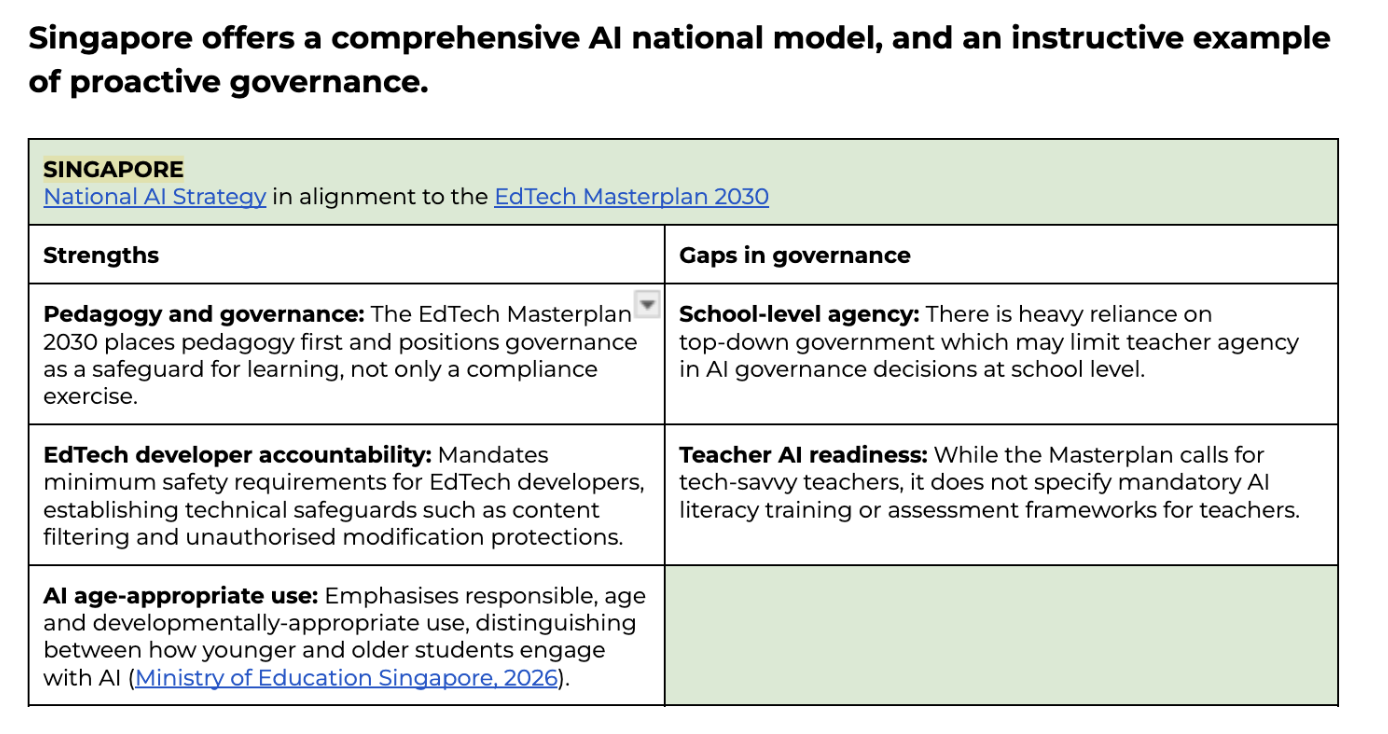
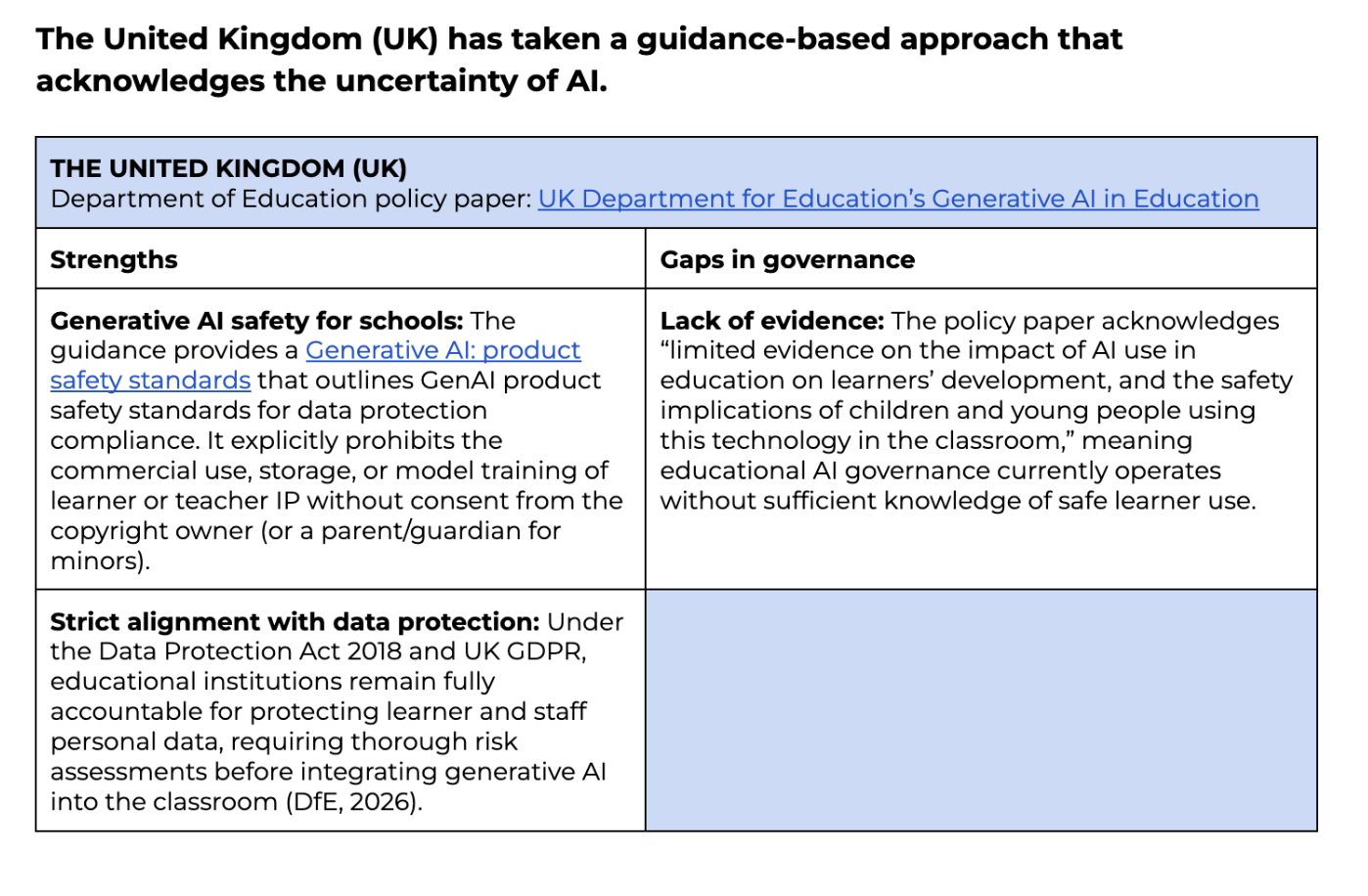
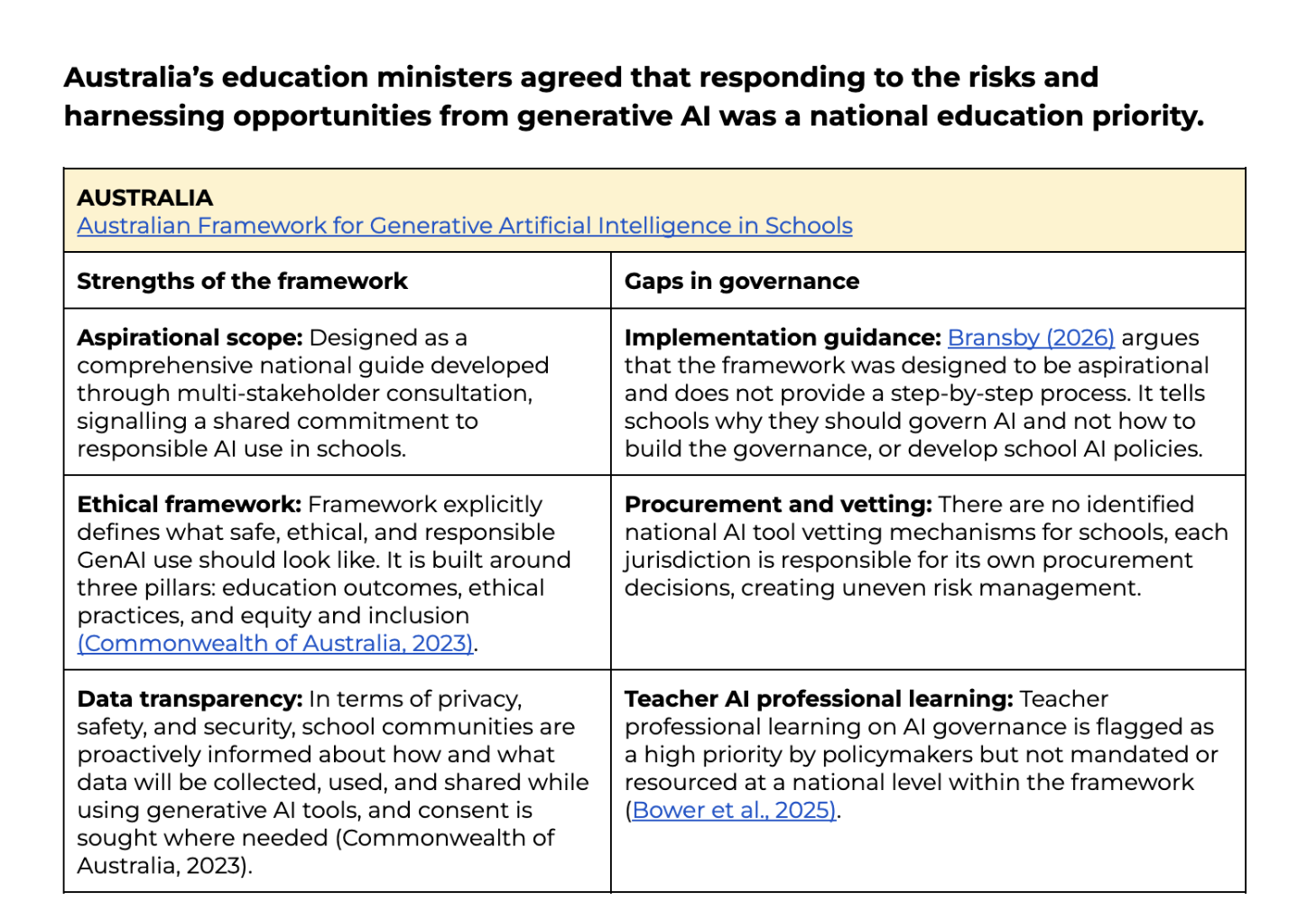
Countries such as Singapore, the United Kingdom, and Australia can be drawn on for key learnings, particularly given the limited examples of AI safeguarding policies in education currently in place within the African context. Singapore's Ministry of Education AIEd Ethics Framework (2024) centres on four core principles: fairness, accountability, transparency, and safety, guiding how AI is integrated into schools. The OECD TALIS 2024 Survey further recognises Singapore as a global leader in teacher professional development for AI, underpinned by strong government AI strategies (OECD, 2024; Anton, 2026). Australia was among the first countries to develop a nationally endorsed, school-specific AI framework anchored in privacy, security, and safety, produced through a National Taskforce comprising key bodies including the Australian Government, the Australian Education Research Organisation, and Education Services Australia (Bowman, 2023). The United Kingdom's Department for Education likewise took early action by publishing Generative AI Product Safety Expectations, establishing national-level safety standards for the EdTech supply chain (Bharati, 2026).
A comparative analysis of these international frameworks reveal several shared trends in educational AI governance. The frameworks analysed above acknowledge that learner data needs to be protected, especially when handled by EdTech companies or third parties. Secondly, teacher AI readiness is acknowledged, however not mandated. Despite differences in approach and maturity, all three frameworks share a structural goal: they are principle-driven and aspirational by design, however lack enforcement mechanisms. Singapore’s governance model is not inclusive of various stakeholder decision-making, the UK’s guidance is explicitly non-statutory, and Australia’s framework has been described as telling scholars why they should govern AI without specifying how. Although these comparative frameworks show clear strengths, they have not yet fully resolved the issue of learner data privacy due to gaps in governance. Nevertheless, their shift toward urgent, research-led government action provides a strong model for South Africa to learn from and adapt locally.
Key lessons for shaping South Africa's future AI framework
1. A national learner AI data protection framework with enforceable standards is needed. The African Union Development Agency-NEPAD explicitly calls for enhanced safeguards in high-risk applications, noting that AI systems used with minor learners should be subject to stricter protections, including age-appropriate design and stronger oversight mechanisms (AUDA-NEPAD, n.d). The responsibility for ensuring safe and ethical AI use in education cannot rest solely on individual schools. Much like Australia’s AI in education framework approach, Paschal and Melly (2023) state that educational institutions, policymakers, EdTech developers should collaborate to develop and enforce ethical standards that ensure AI systems enhance the educational experience without compromising student privacy. Comprehensive national and provincial policies need to be developed to guide and support schools in navigating this technological shift. Therefore, this framework needs to include enforceable data governance standards for AI in education solutions used in schools specifically for protection of learner data.
2. Establishing teacher AI competency should be a policy priority. Much like policymakers in Australia flagging teacher development in AI knowledge as a foundational pillar, Saal et al. (2025) highlight teacher training as a critical gap in South African primary and secondary schools. The authors argue that teachers need to be better equipped to understand data protection and privacy laws. By embedding AI competencies into formal teacher training, teachers gain necessary AI knowledge, and ultimately function as essential overseers who can identify AI inaccuracies, and steer learners towards safe and constructive AI use (UNESCO, 2024).
3. AI literacy should be embedded in the national curriculum. To bridge the widening digital divide, AI literacy should be formally woven into the national CAPS curriculum. According to a UNESCO report on AI competency framework for students, only 15 of 190 countries were developing or implementing AI curricula in schools in 2022, and South Africa was not one of those countries (Miao et al., 2024). The curriculum should expand to focus on digital safety in the classroom where learners are not only taught how to use AI, but to also emphasize data privacy rights, and champion the responsible and ethical use of AI solutions.
South Africa can no longer treat AI as a distant policy milestone, but rather as an urgent classroom reality requiring robust, dedicated educational governance. By synthesizing the pedagogical structure of Singapore, the strict data safeguards of the United Kingdom, and the equity-driven framework of Australia, the Department of Basic Education can construct a localised roadmap tailored to South Africa’s specific education context. Prioritising enforceable data standards, teacher support, and curriculum-integrated AI literacy will ultimately transform this regulatory race against time into a safe, empowering digital safety for all South African learners.

.png)
.png)